
Most brokers think they know what their business is worth.
They take their annual trail, multiply it by three and picture the number sitting in their bank account the day they retire.
That number is often wrong. Sometimes it’s wildly wrong. And the gap between what you think you’ll get and what you actually get usually comes down to one thing: whether you’ve built a trail book or a business.
This guide breaks down how mortgage broking businesses are valued in Australia, what you might realistically expect when you sell and the practical steps that separate a business that sells for a premium from one that sells for scraps (or doesn’t sell at all).
Whether you’re planning to exit in twelve months or twelve years, this is the playbook.
Let’s dive in.
Contents
- Chapter 1: Book vs Business (The Distinction That Doubles Your Money)
- Chapter 2: How Mortgage Trail Books Are Actually Valued
- Chapter 3: The 6 Factors That Move Your Trail Multiple
- Chapter 4: How a Whole Business Is Valued (And Why It’s Worth More)
- Chapter 5: The Risks That Quietly Destroy Your Value
- Chapter 6: How to Maximise Value Before You Sell
- Chapter 7: Own Your Data (The Value Lever Hiding in Your Tech Stack)
- Chapter 8: Succession vs Sale (Choosing Your Path)
- Chapter 9: Preparing for a Clean Exit
- Chapter 10: The Handover (Where Value Is Won or Lost)
- Chapter 11: Frequently Asked Questions
- Start Building the Sellable Business Today
Chapter 1: Book vs Business (The Distinction That Doubles Your Money)
Let’s start with the single most important idea in this entire guide.
There are two very different things you can sell:
- You can sell a trail book. That’s an income stream. A buyer takes on your run-off trail commission, and that’s it. They buy the asset and walk away.
- Or you can sell a business. That’s a system. Something that keeps running, keeps writing loans and keeps generating income after you’ve handed over the keys and driven off into the sunset.
The difference in what you walk away with is enormous.
A trail book in Australia typically sells for somewhere around 2.5 to 3 times your annual trail. A genuine business, one that runs without you, is valued on a different basis entirely and commonly fetches 4 to 6 times EBITDA, sometimes more. (We break down both figures, the sources behind them, and an important caveat about current market conditions, in Chapters 2 and 4.) For a lot of well-run brokerages, those two numbers aren’t even close.
Here’s the test that decides which camp you’re in.
If you walked out the door tomorrow and never came back, would the phone keep ringing? Would the loans keep getting written? Would the clients stay?
For most brokers, the honest answer is no. And that’s the whole problem.
If the business can’t survive without you, then you’re not selling a business. You’re selling a book with your name attached to it. The moment you leave, the value leaves with you.
The more valuable you are to your business, the less valuable your business is.
Read that twice. It’s the opposite of what most brokers believe. You spend your whole career becoming indispensable, being the person every client wants to talk to, the one who touches every deal. And in doing so, you quietly make your business harder to sell.
Income vs Equity
There’s nothing wrong with running a great income business. If your brokerage pays you well and funds a good life, that’s a genuine win.
But understand the trade-off. An income business and an equity business are built differently.
An income business is optimised to put money in your pocket this year. An equity business is optimised to be worth something to someone else when you’re ready to leave. If your goal is a big payday at the end, you need to start making decisions that build transferable value, not just personal income.
The good news? Almost everything that makes your business more valuable to a buyer also makes it more profitable and more enjoyable to run today. You don’t have to choose between the two. You just have to be deliberate about it.
Chapter 2: How Mortgage Trail Books Are Actually Valued
Before we get to businesses, let’s nail down how the book itself is priced. Because even if you build the perfect business, the trail book sits at the core of the valuation.
First, a quick refresher on why trail is the asset that matters.
The commission model (and why trail is king)
When you settle a loan, you get paid twice.
You earn an upfront commission, usually around 0.65% to 0.70% of the loan amount plus GST. On a $500,000 loan, that’s roughly $3,250 before GST in your pocket at settlement.
Then you earn a trail commission, usually around 0.15% per year of the outstanding balance for the life of the loan. At 0.15% on that same $500,000 loan, that’s about $750 in the first year, declining slowly as the borrower pays down the principal.
The upfront is a one-off. It’s also often exposed to clawback, meaning if the loan gets refinanced or repaid inside usually the first year or two, the lender takes some or all of it back. Terms vary by lender.
The trail is different. Trail is an annuity. It keeps paying, month after month, whether or not you write another loan. That predictable, recurring income is exactly why a trail book is a saleable asset, and why buyers will pay a multiple for it.
The trail book multiple
Here’s what trail books are changing hands for right now.
Longtime brokers will remember when a trail book changed hands closer to 2 times annual trail. Those days are gone.
In today’s market, independent fair-value appraisals sit at around 2.4 times annual trail. But actual sale prices have run higher than that. Strong buyer demand pushed the average sale multiple to about 3 times annual trail in FY24-25, up 6% on the prior year, with strong books fetching more and weak books fetching less.
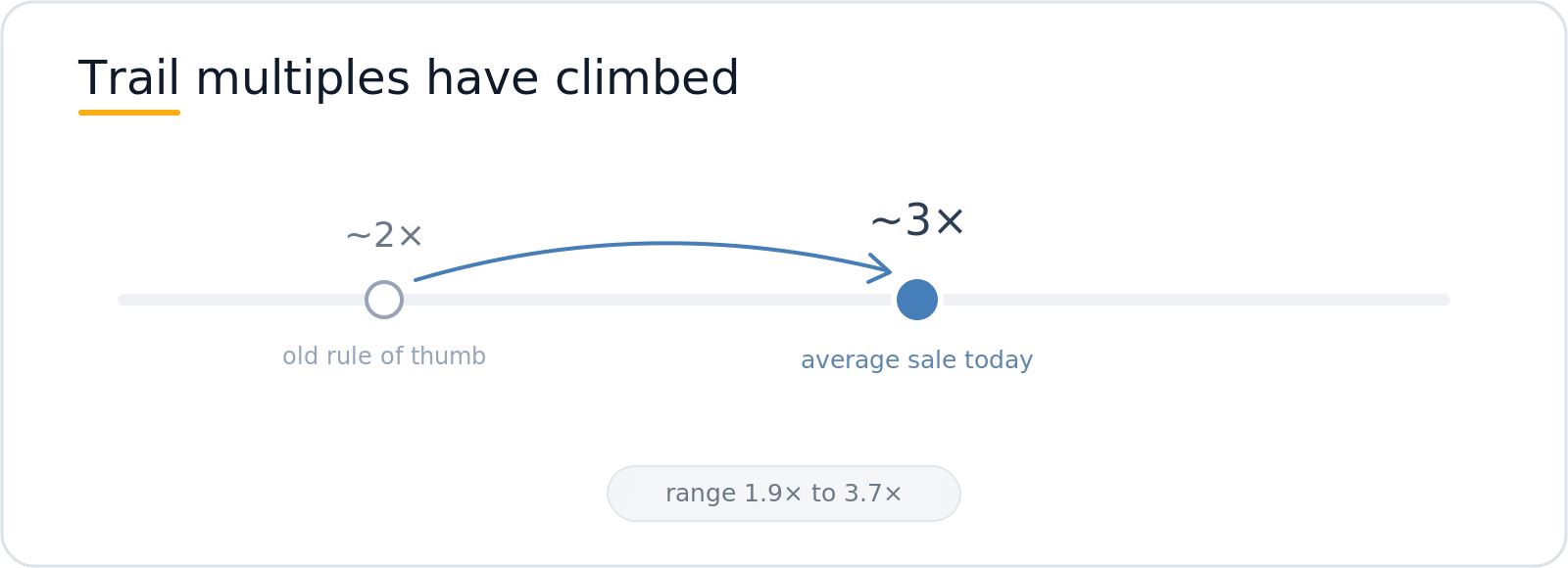
The range in the current market runs from roughly 1.9x for a weak book to 3.7x for a premium one. One published industry price guide (Radar Results) puts prime residential books in the 2.75x to 3.75x band. That’s a spread of nearly 50% on the exact same income, purely based on quality.
Actual dollar outcomes are all over the map. Recent sales have ranged from about $100,000 to more than $2 million, averaging around $250,000. It depends entirely on the size and quality of the book.
A worked example
Let’s make this real. These figures are illustrative, but the multiples are drawn from the current market range above.
Say your book generates $200,000 in annual trail.
- At a weak-book multiple of 2x, that’s $400,000.
- At the market average of 3x, that’s $600,000.
- At a premium 3.5x, that’s $700,000.
Same book. Same income. A $300,000 difference based on nothing but the factors we’ll cover in the next chapter.
This is why understanding what drives the multiple matters so much. A few percentage points of run-off, a cleaner spread of lenders, better seasoned loans and you’re looking at a materially bigger cheque.
One important caveat
Trail values are high right now. Some of the people who value these books for a living have openly called it a bull market and warned it looks overheated.
Part of the reason values have climbed is simply that property prices and loan sizes have climbed. Bigger loans mean bigger trail. That’s a reminder that part of the current strength reflects loan size, not necessarily the quality of the books being written.
If property flatlines, rates move sharply or the commission structure changes, book valuations could correct. That’s not a reason to panic. It’s a reason to build real business value that doesn’t depend on a frothy market, which is exactly what the rest of this guide is about.
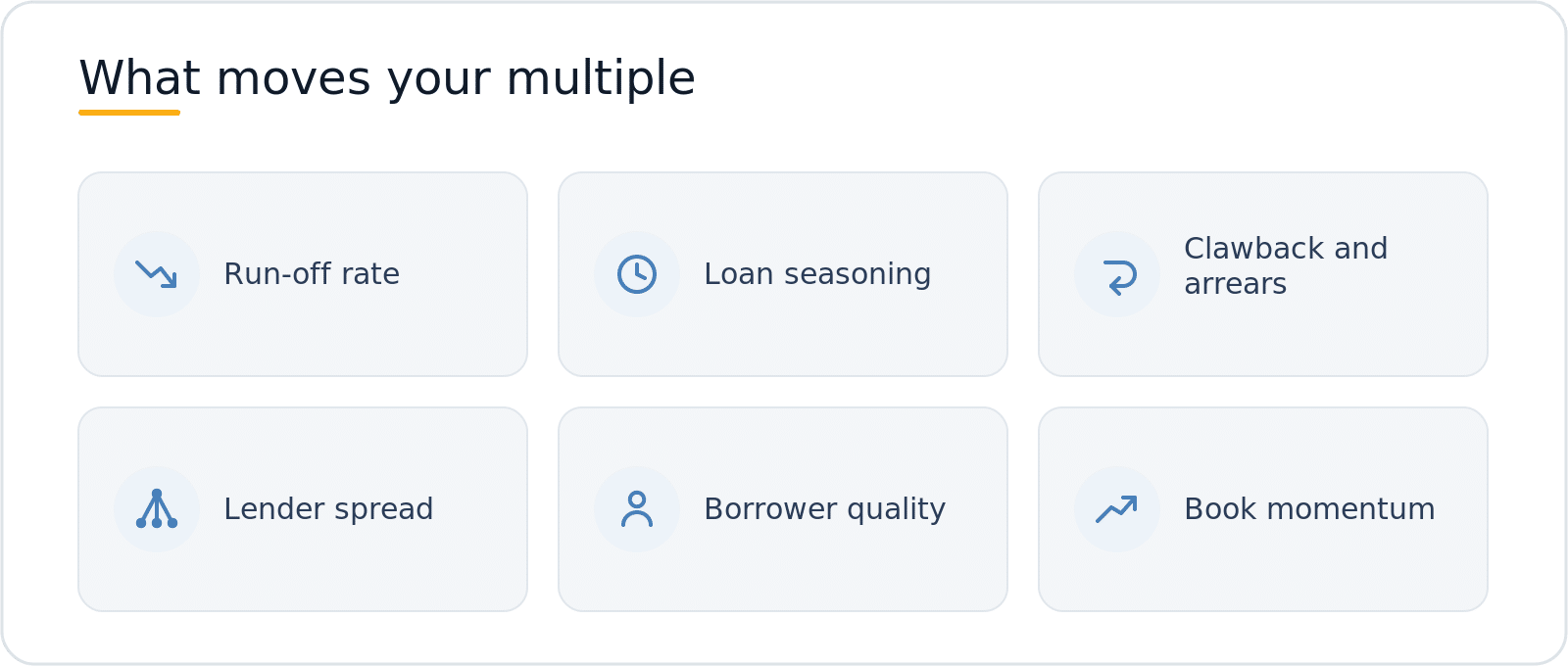
Chapter 3: The 6 Factors That Move Your Trail Multiple
Two books with identical trail income can sell for prices that differ by 50% or more. Here’s what separates the premium book from the discounted one.
1. Run-off rate (the big one)
Run-off is the rate at which your book shrinks each year as loans get refinanced, repaid or discharged. It is arguably the single most important number in the whole valuation.
Why? Because a trail book is a wasting asset. Every loan that runs off is trail you’ll never collect again.
Typical industry run-off sits at around 15% to 20% a year. In the recent refinancing boom it climbed higher, with measured run-off peaking above 25% before easing back toward 23%.
Here’s what that means in plain terms. If your book is running off at 25% a year, then after three years only about half your trail is still there. A buyer knows this. The faster your book bleeds, the less they’ll pay for it.
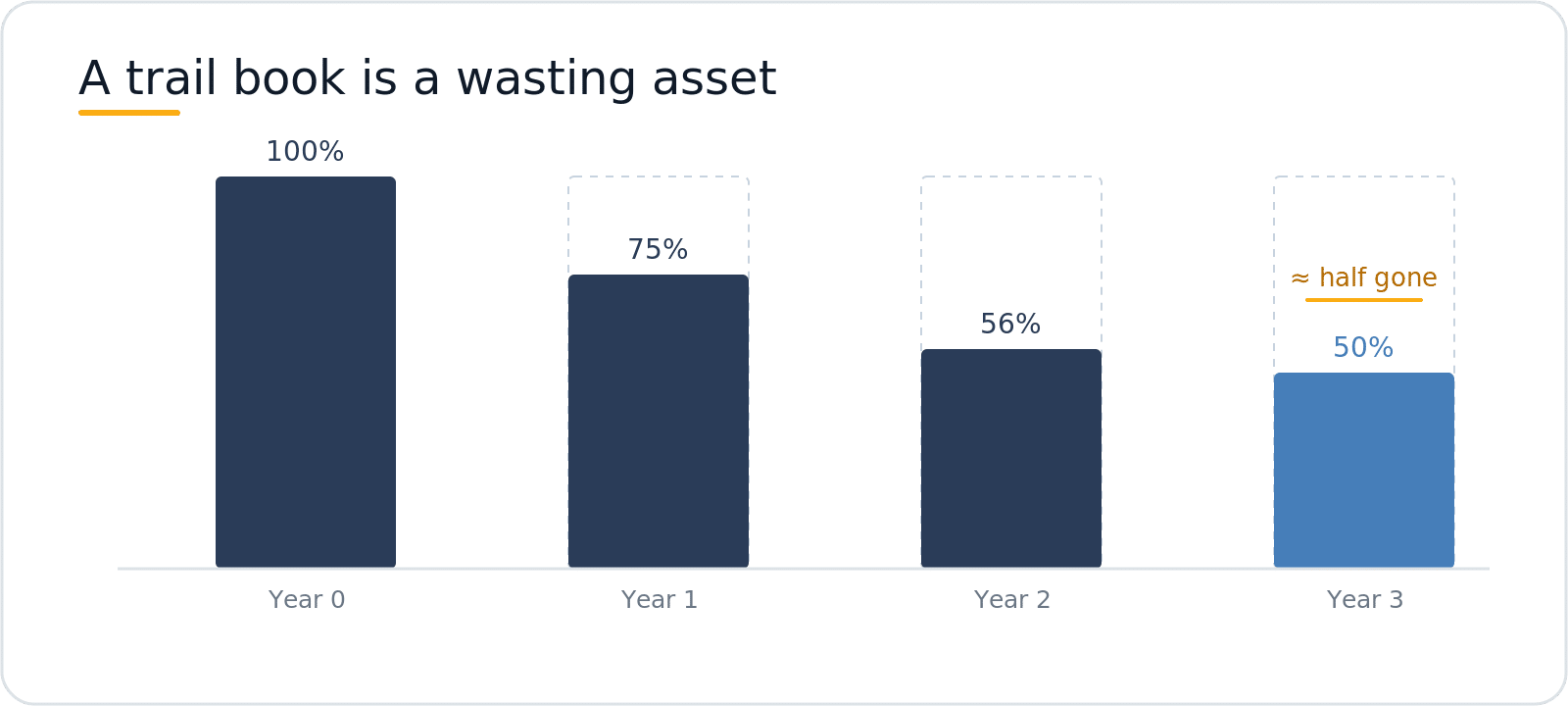
Illustrative at about 25% annual run-off, near recent industry highs. Sources: The Adviser, MPA (2025–26).
The best brokers keep run-off much lower through relentless client retention. More on how in Chapter 6.
2. Loan seasoning
Buyers love loans that are aged, but not too aged.
The sweet spot is loans that are 24 to 60 months old. Old enough that they’re past the clawback window and the heaviest refinance risk, so they’re sticky. Young enough that the borrower hasn’t paid the balance right down.
A book stuffed with brand new loans carries clawback risk. A book full of ancient, heavily paid-down loans carries low future trail. The middle is where the value lives.
3. Clawback and arrears
A high clawback rate is a red flag. It suggests churn, or loans written that didn’t stick, which raises questions about how the book was built.
As a rough guide, a clawback rate under 5% is healthy, 5% to 10% is normal, and anything north of 15% will make a buyer nervous. Industry clawback recently sat around 10%, elevated by cashback-driven refinancing.
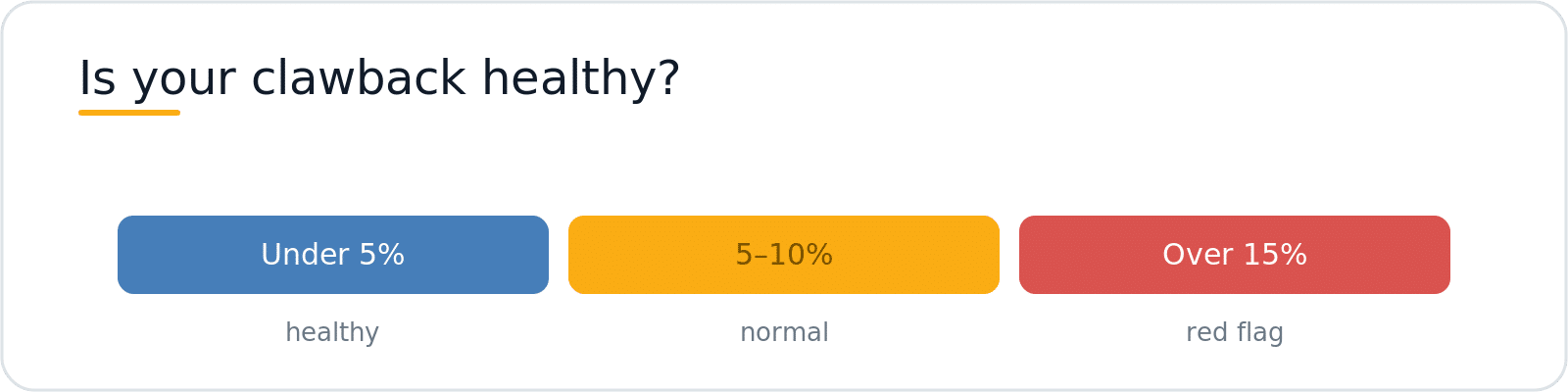
Industry clawback recently around 10%. Source: MPA (2026).
4. Lender spread
A book concentrated with one or two lenders is riskier than one spread across many. If a single lender changes its commission terms or pricing, a concentrated book takes the full hit. Diversification across funders earns a better multiple.
5. Borrower quality
Not all clients are equal in a buyer’s eyes. A-grade borrowers who are financially stable, who have ongoing lending needs and who are likely to stay, are worth more than a book of one-and-done transactional clients. Younger clients with growing needs (upgrades, investment, refinancing down the track) add value.
6. Book momentum
Finally, is the book growing or shrinking? A book that’s actively adding new, well-seasoned loans faster than it runs off is a very different proposition to one in quiet decline. Momentum signals a living business, not a fading one.
Chapter 4: How a Whole Business Is Valued (And Why It’s Worth More)
When you sell a business rather than a book, the maths changes completely. Instead of a multiple of trail, buyers apply a multiple to your EBITDA (your earnings before interest, tax, depreciation and amortisation, or roughly your normalised profit).
And this is where the real money is.
The multiple that matters
A bare trail book sells for around 2.5 to 3 times trail.
A genuine business (systems, staff, brand, a referral engine, recurring profit that doesn’t depend on you) is valued on an EBITDA multiple instead. As a broad Australian benchmark, established small businesses with reliable recurring revenue commonly change hands at around 4 to 6 times EBITDA, and larger, more systemised firms can command more.
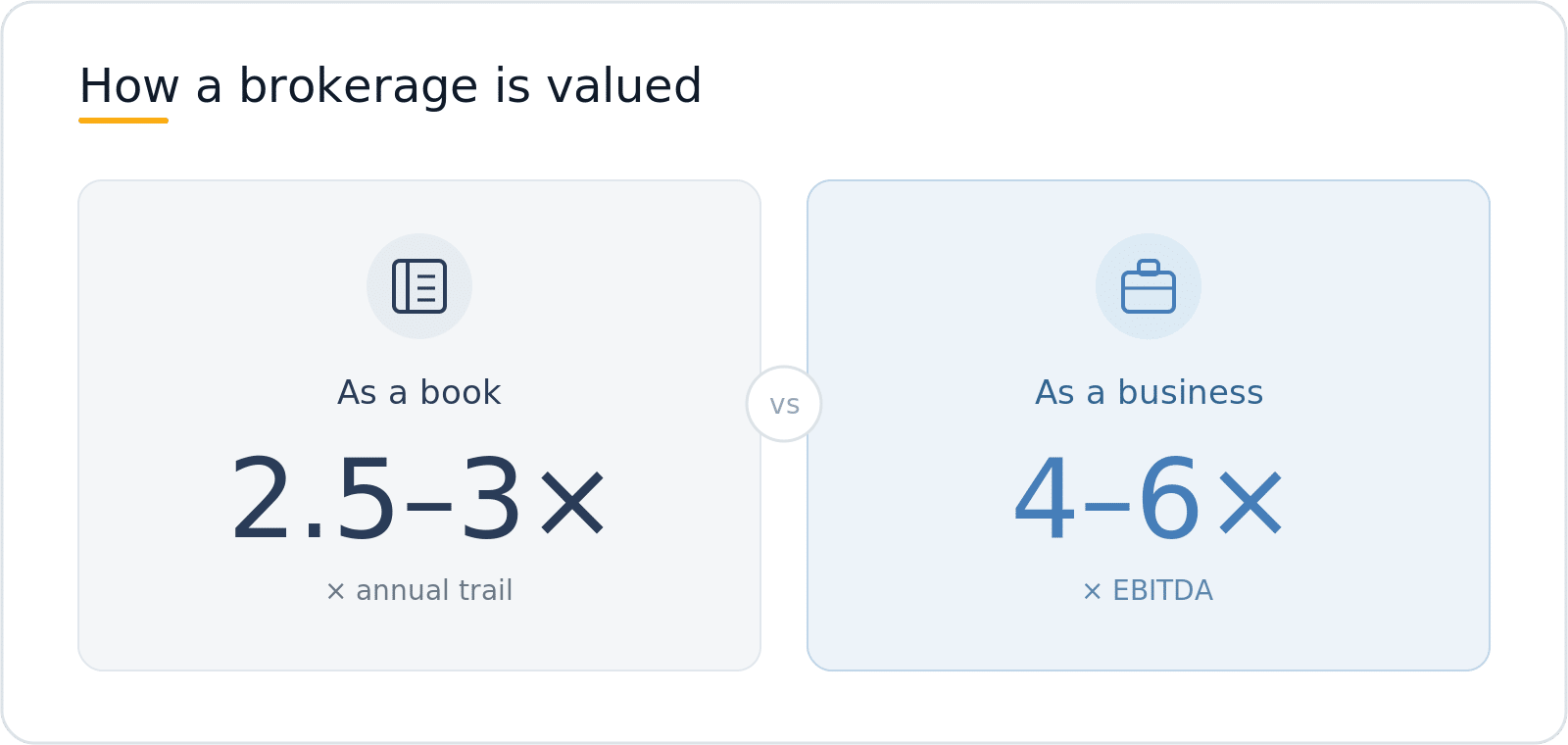
Trail books and businesses are valued on different bases. Sources: The Adviser, MPA, Nash Advisory (2025–26).
Here’s a rough way to compare the two, though keep in mind a book multiple applies to your trail while a business multiple applies to your EBITDA, so this is illustrative rather than exact. In a well-run brokerage on a healthy margin, annual trail and EBITDA often land in a broadly similar range. On that basis, selling as a book might fetch around 3 times, while selling as a business could fetch 4 to 6 times the equivalent figure.
That gap is not a rounding error. For illustrative purposes only, on a firm with, say, $300,000 of EBITDA, the difference between a 3x outcome and a 5x outcome is around $600,000.
What buyers actually assess
So what makes a buyer treat you as a premium business instead of a discounted book? Based on how sophisticated acquirers evaluate broking firms, these are the levers that matter most.
- Scale: Bigger businesses carry less risk per dollar and more room to grow, so they attract higher multiples. More loan writers, a bigger book and diversified income all reduce the buyer’s risk.
- Systemisation: This is the big one. Can the business run on documented processes rather than what’s inside your head? Buyers want to see workflows, clear responsibilities and a business that doesn’t collapse if one person leaves. Perfect isn’t required. Maintainable and transferable is.
- Operating model: How your loan writers are engaged matters. Businesses built on employed brokers with clear ownership of the client book and trail tend to attract a higher multiple than those reliant on contractors or loose arrangements, because there’s more control and less risk of the value walking out the door.
- Quality of earnings: Clean, predictable, well-documented income beats lumpy income every time. Recurring revenue, low clawback and stable margins all support a stronger price.
- Growth profile: A business with a credible growth story and the capability to execute it is worth more than one that’s plateaued.
- People and culture: Depending on the buyer, your team can be a huge part of the value, especially good support staff and brokers who are hard to recruit. Cultural fit often sits right at the top of a buyer’s checklist, because a great book is worthless to them if the people who service it walk out the week after settlement.
You’ll notice one thing missing from that list: your own indispensability. Over-reliance on you is the single biggest risk a buyer prices in, and it’s such a deal-breaker that it heads up the next chapter.
Platform vs tuck-in
One more idea worth understanding. Buyers think of acquisitions in two ways.
- A platform business is one they build around. It has the systems, the team, the reporting and the brand to become a hub. Platform businesses command premium multiples, often significantly higher than the alternative.
- A tuck-in is a smaller book or business they simply fold into something they already own. Tuck-ins get lower multiples.
The difference between being a platform and being a tuck-in is, again, systems and people. Build those, and you may sell at the top of the range.
Chapter 5: The Risks That Quietly Destroy Your Value
Here’s a reframe that changes how you think about selling.
You don’t make your business more valuable by telling a better growth story. You make it more valuable by making it less risky. Risk reduction equals sellability. Every risk a buyer spots gets priced in as a discount, or worse, kills the deal in due diligence.
Chapter 4 was the scorecard: what earns you a premium. This is the flip side. The specific landmines a buyer hunts for in due diligence, each one a reason to knock money off the price or walk away entirely. Start with the biggest.
- Key person risk: If the business depends on you, or on any single person, that’s the number one value killer. Buyers do not write big cheques for businesses that collapse the moment someone takes a holiday. The counterintuitive move here: don’t try to impress a buyer with how hard you work. Impress them with how little the business needs you.
- Client concentration risk: If a big chunk of your revenue comes from one referral partner or a handful of clients, a buyer sees a business that could lose a huge slice of income overnight. Spread your sources.
- Lead and channel risk: If every lead comes from one source (one referrer, one aggregator relationship, one ad account), that’s fragile. Buyers want to see a mix: referral, organic and channels you own like your database and repeat clients.
- Financial risk: Messy books, personal expenses run through the business and sloppy records will spook a buyer faster than almost anything. Bad books are one of the most common reasons a deal falls apart in due diligence. Clean financials signal a clean business.
- Compliance risk: Unresolved compliance issues, poor record keeping or questions over how loan writers are classified can stall or sink a deal. Get this tidy well before you go to market.
Deal with these, and you’ve done most of the work. In fact, the single act of building a documented operating system quietly solves most of them at once.
Chapter 6: How to Maximise Value Before You Sell
Right. You understand how you’ll be valued and what drags value down. Now here’s the practical playbook for building a business that sells for a premium.
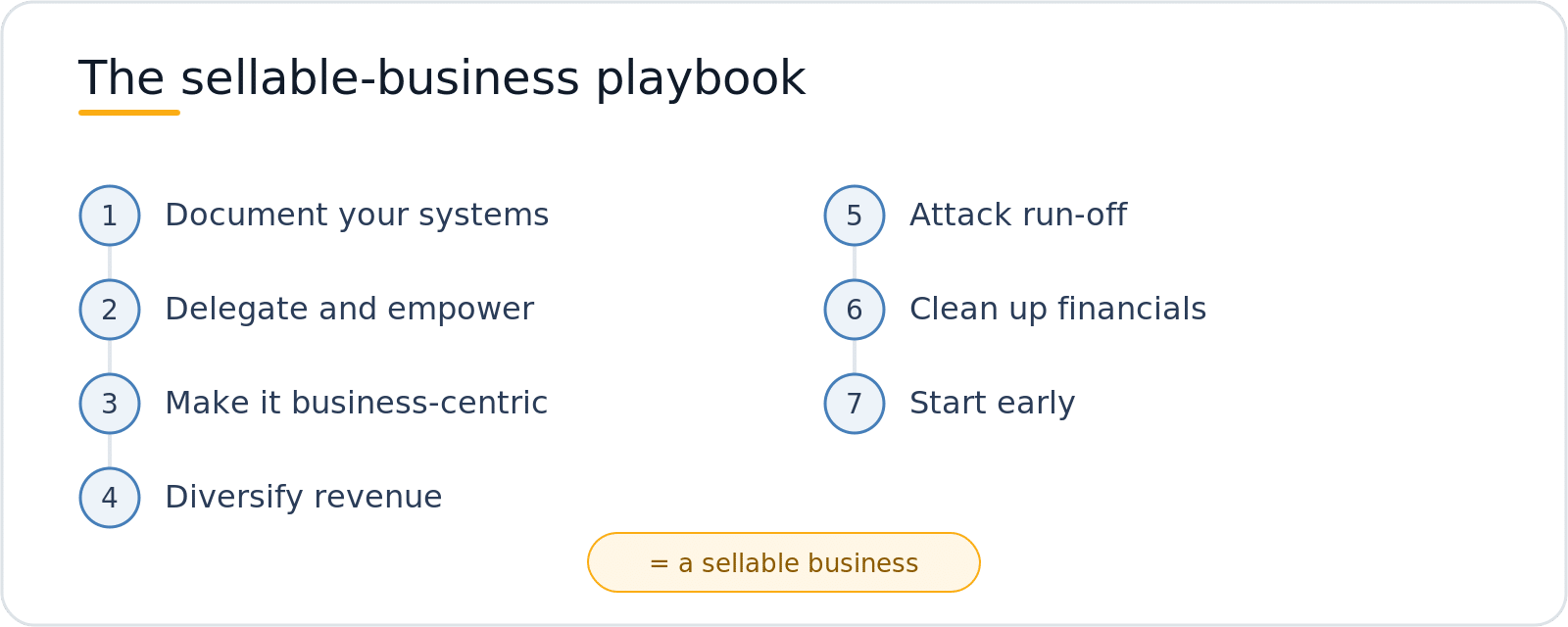
1. Document your processes and systems
Cue the eye-roll. Documenting processes is nobody’s idea of fun, and it’s not in the DNA of most brokers, who got into this to write loans and help people, not to write procedures.
But this is the highest-leverage thing you can do. A buyer needs to run the business without you, which means the good stuff has to come out of your head (and your team’s heads) and into clear, documented operating procedures.
One rule: less is more. Don’t try to map every tiny task. Document the most important functions (your sales process, deal processing, client onboarding, compliance) so a buyer can see the business runs on a system, not on you.
This is exactly where a purpose-built platform earns its keep. When your workflows, checklists, client communications and deal data all live in one system like BrokerEngine, the systemisation isn’t a binder on a shelf that goes stale. It’s embedded in how the business actually operates every day, and it transfers straight to a buyer. That’s the difference between selling a book and selling a business.
2. Delegate and empower your team
Build a leadership team that can make decisions without you. Give the right people real authority in their areas, backed by reporting so you know what’s happening without being the bottleneck.
Start slowly and monitor progress. The right people tend to rise to the challenge. Every decision you successfully hand off is one less way the business depends on you.
3. Make it business-centric, not owner-centric
Your clients want to talk to you. You feel you owe them that. But if every relationship runs through you, then every relationship leaves with you.
Introduce clients to other members of your team. Assign key clients to senior people. Shift the loyalty from you to the business. This is hard, and it’s worth it, because a book of clients loyal to a brand transfers cleanly, while a book loyal to a person doesn’t transfer at all.
4. Diversify your revenue
A brokerage that only writes residential mortgages is worth less than one that also does asset finance, commercial lending or insurance. Diversification adds resilience, increases your share of each client’s financial life, and appeals to a wider pool of buyers. It also smooths income, which improves earnings quality.
5. Attack your run-off with a retention engine
Remember, run-off is the biggest single driver of book value. Every client you keep is trail you keep, and a lower run-off rate directly lifts your multiple.
Build a structured retention process:
- Proactive annual reviews, booked in advance
- Repricing with the client’s existing lender (a simple way to save them money and keep them, without the hassle of refinancing)
- Regular, genuine touchpoints: settlement anniversaries, check-ins, market updates
- An always-on marketing program so no client slips through the cracks
Repricing alone is powerful. One repricing provider found that proactively repricing clients with their current lender cut churn by 32%. Stay front of mind, or you’ll lose those clients to the banks.
6. Clean up your financials and compliance
Get your books in order long before you sell. Have them reviewed by a competent accountant. Stop running personal expenses through the business. Tidy your compliance and licensing records. A clean, professional operation inspires buyer confidence and defends your valuation when the scrutiny comes.
7. Start early (the six-week holiday test)
Reducing your business’s dependence on you takes years, not months. Begin well before you plan to sell.
Here’s a test worth running. Gradually reduce your hours and watch what happens. Then take a proper break (a six-week holiday with your email off is the gold standard) and see whether the wheels keep turning.
If they do, congratulations. That’s strong evidence you’ve built a business that runs without you, not just a job with a trail book attached. If they don’t, you’ve just found exactly what to fix, with plenty of time to fix it. And there’s a lovely side effect: the less the business needs you, the more time you get to spend on the parts you actually enjoy, long before you ever sell.
Chapter 7: Own Your Data (The Value Lever Hiding in Your Tech Stack)
Chapter 6 was about building systems. This chapter is about systems and data, and who controls them?
That single choice quietly decides two things that matter enormously at sale time. How many buyers can realistically acquire you, and how much friction they face when they do. And friction, as we’ve seen, is just another word for discount.
The question behind the question: data sovereignty
There’s a difference between technology your firm uses and technology that runs your firm. Most brokers use an aggregator platform, an email tool, spreadsheets and a lot of knowledge held in people’s heads. The information lives in different places, and the team stitches it together.
Because a buyer isn’t just buying your trail. They’re buying your client records, your deal history, your pipeline, your workflows and your reporting. And the first thing a serious buyer asks is: can I actually get all of that, cleanly, and run it from day one?
This is what data sovereignty means. Are you free to do what you like with your data, or is it held under lock and key by a third party?
Two quick tests:
- If you decided to change aggregators tomorrow, how much of your business could you take with you?
- When you sell, can a buyer clearly see, and easily inherit, exactly what they’re buying?
If either question makes you wince, you have a portability problem. And a portability problem is a valuation problem.
Why lock-in shrinks your buyer pool
When your client data, IP and workflows are locked inside one aggregator’s software (or scattered across spreadsheets and inboxes), you have narrowed the pool of people who can buy you. A buyer with a different aggregator now sees a migration project: can the data even be extracted? Will it transfer cleanly? What breaks in the process?
Every one of those question marks gets priced as risk. And as we covered in Chapter 5, risk is a discount. Buyers worry about buying a book, trying to integrate it and running it properly. That hassle is real, and they factor it straight into your price, if they bid at all.
A narrow buyer pool is also a weak negotiating position. The fewer people who can comfortably acquire you, the less competitive tension there is on price.
Why portability widens it (and lifts the price)
Now flip it.
When your systems and data live in a portable layer that you own, one that sits above your aggregator rather than inside it, the picture changes completely. You’re no longer chained to a single aggregator. Your workflows, client history and processes can move with the business, intact.
This is exactly what an aggregator-agnostic operating system like BrokerEngine is built to do. Your client data, workflows and reporting sit in a layer you own, and the aggregator’s lodgement simply plugs into it. Change aggregators and your operating system stays put. That widens your buyer pool, because a buyer with any aggregator can take you on without ripping anything out.
And it gets better when the buyer already runs BrokerEngine. Then the transfer is close to trivial: your entire firm can be folded straight into their account, or kept running as its own sub-account, in days rather than months.
This is exactly why a business built on transferable, owned systems is often worth more than an identical one that isn’t. Value that can’t be transferred cleanly isn’t worth much to a buyer. Owning your data and your processes is that principle applied to your technology.
Running vs renting
There’s a simple way to think about it. When your data and processes live in a system you control, you’re running a brokerage. When they live inside someone else’s platform on someone else’s terms, you’re renting one. Renters have fewer options, and fewer options means less leverage.
That is the whole case for owning your operating layer rather than borrowing your aggregator’s. More buyers, less friction and a business that can move to a new owner without falling apart in transit. It is what protects your price, all the way through to the handover.
Chapter 8: Succession vs Sale (Choosing Your Path)
Selling to a stranger is only one way out. Before you assume that’s the plan, get clear on what you actually want. Because succession and sale need slightly different preparation, even though the foundations are identical.
The three common pathways
Most exits fall into one of three buckets:
- Sell outright: A clean break. You sell the book or the whole business, hand over and walk away. This maximises your upfront payout but requires a strong handover process to protect the value.
- Pass it to someone you know: Transfer the business to a family member or a key team member. This preserves your legacy and gives clients continuity, but it takes time to train, mentor and gradually transition responsibilities, often years.
- Merge or sell part of the business: A partial sale or merger lets you step back gradually while retaining some income from trail or equity. It can also bring in capital and capability to help the business grow and help you keep good people.
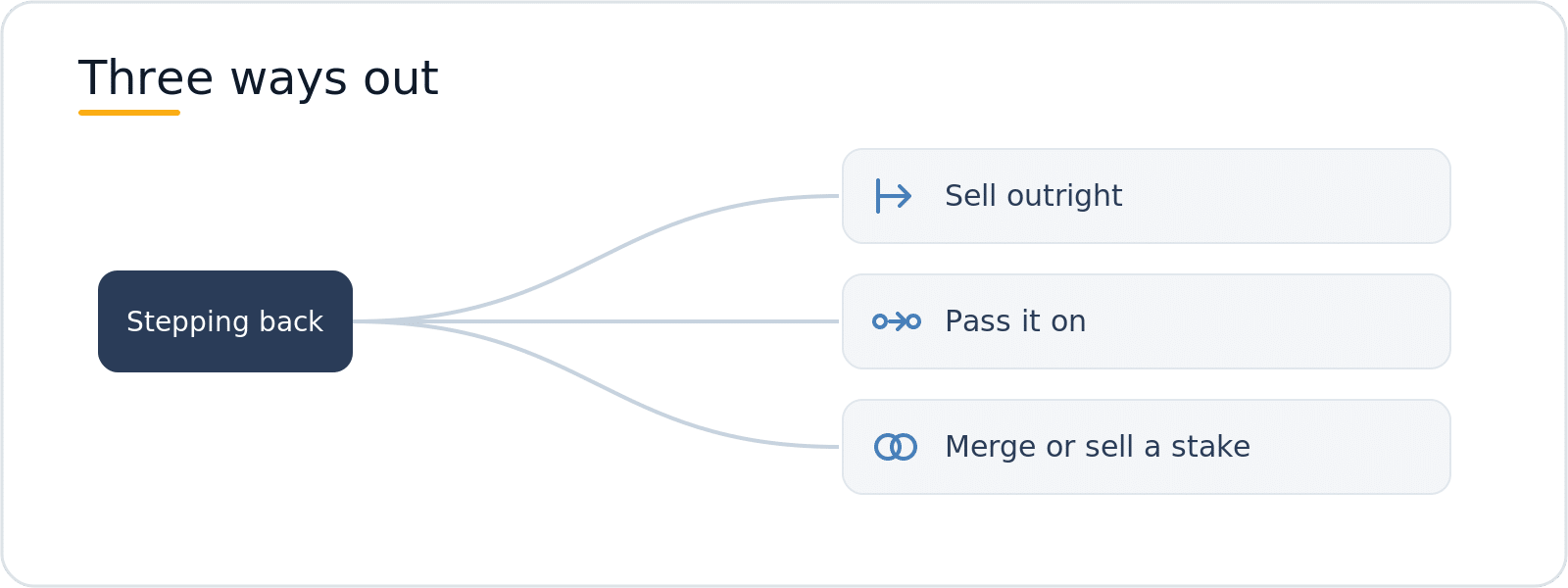
There’s no single right answer. The best path depends on your goals, your timeline and who’s around you.
Why succession is a valuation pillar
Even if your business can run without you, a buyer’s very next question is: who’s going to run it, and how?
That’s why succession isn’t separate from value. It is value. Clearly defined roles, documented responsibilities and an identified next-in-line mean someone can step into the leadership seat and follow the bouncing ball. That confidence is worth real money, whether you’re handing to family or selling to a third party.
The messaging is almost the same for both paths: if it’s all systemised and documented, you’re not having to pull everything out of your head to hand it over. It’s already there, embedded in the business.
Start with the end in mind
The earlier you define your exit, the more options you have. Ask yourself:
- What level of involvement do I want after the transition? Clean break, or stay on in a reduced role?
- Who is the most likely successor? What training and mentoring will they need?
- What income do I want to retain post-exit? (Keeping some trail changes your strategy.)
- Is the business actually structured to operate without me?
Your answers shape everything about how you structure the deal.
Timeframes matter
A good succession plan takes years. Keep this simple timeline in mind:
- 2 to 3+ years out: Get the business in shape and identify your successor. Document your processes, tighten your team structure and retention, and start reducing how much runs through you.
- 12 to 18 months out: Transition responsibilities, mentor your successor and bring in your advisers (accountant, lawyer, business broker).
- Final 6 months: Lock in the details, communicate the plan internally and prepare your clients for the shift.
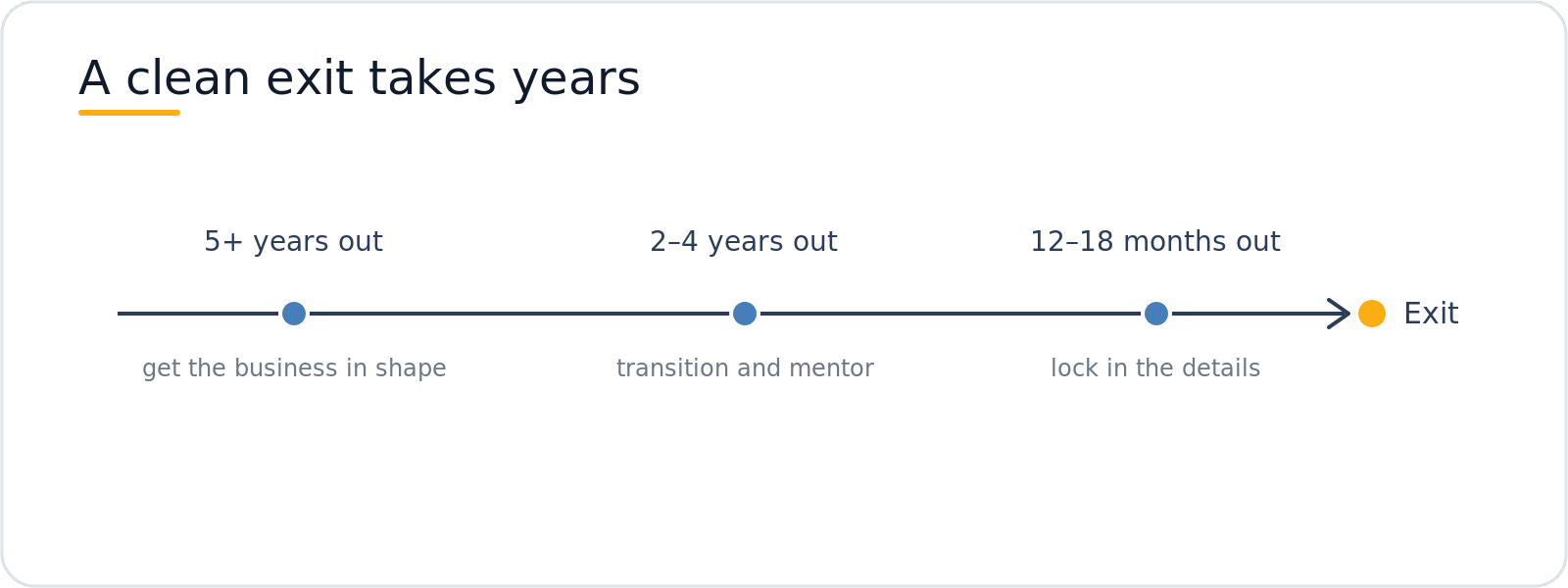
The brokers who leave this too late are the ones who end up taking whatever the market offers, because they’ve run out of time to build anything better.
Chapter 9: Preparing for a Clean Exit
You’ve built the value. Now protect it through the transaction itself, because a rushed or clumsy exit can undo years of work.
Build your team of advisers
A smooth exit usually needs a few professionals in your corner:
- An accountant to prepare and review your financials and help maximise your valuation
- A lawyer to draft and review contracts and manage compliance
- A business broker to find and vet buyers, negotiate and run the sale process
Engage them early. Early engagement gives you time to fix issues proactively, rather than scrambling when a buyer’s due diligence surfaces them.
Understand how these deals are structured
Broking sales rarely come as a single lump sum on day one. Expect a structure that protects the buyer against the risks unique to our industry:
- Cash plus deferred consideration: A large portion is usually paid up front, with the rest deferred and tied to performance.
- Earn-outs: Part of the price depends on the business hitting agreed targets after the sale (revenue, profit or client and staff retention), often over a period of one to three years.
- Holdbacks: A slice of the price is held in escrow for a period as security against anything that goes wrong post-settlement.
- Clawback allocation: This one is broking-specific and critical. There’s no standard answer — get your lawyer to negotiate who wears future clawbacks and how retention is handled, rather than agreeing it informally. .
Notice what these structures have in common. Most of them tie a chunk of your money to what happens after you sign. Which makes the handover, covered in Chapter 10, the difference between collecting the full price and watching part of it evaporate.
Clean up the paperwork
Buyers scrutinise everything. Before you go to market, have documented and organised:
- Financial statements (profit and loss, balance sheet)
- Your client data and loan book
- Compliance and licensing documentation
- Operational processes, workflows and contracts
A single, unified system that captures deal activity, client interactions and workflows makes this stage dramatically easier, and gives the next owner full confidence in how the business runs.
Avoid the common mistakes
Most botched exits share the same handful of errors:
- Failing to clean up financial records and documentation
- Not communicating plans and timelines clearly with team and clients
- Leaving professional advisers until the last minute
- Underestimating how long a successful sale or handover actually takes
Most of this is avoidable with early planning.
Chapter 10: The Handover (Where Value Is Won or Lost)
Here’s the part most brokers treat as an afterthought. And it’s the part that decides whether you actually collect the price you agreed.
Signing the contract isn’t the finish line. Because most broking deals are built around earn-outs, deferred payments and clawback retention (see Chapter 9), a big slice of your money depends on what happens after you hand over the keys. A clean handover protects that money. A messy one lets it leak away.
There are two handovers to get right: the business handover and the client handover.
The handover period: you’re not done at settlement
Expect to stay on for a period after the deal completes. This isn’t the buyer being difficult. It’s how they protect what they’ve paid for, and how you protect your earn-out.
During this window you’re transferring the things that never show up on a balance sheet:
- Client relationships, so borrowers stay with the business rather than following you out the door or drifting back to a bank.
- Referrer relationships, arguably the most overlooked asset in the whole deal. The accountants, agents and past clients who send you business need to be warmly introduced to the new owner, or that lead flow dries up the day you leave.
- The know-how in your head, the judgment calls and workarounds that never made it into a process document.
How long and how conditional this period is comes straight back to how founder-dependent your business is. Build a business that already runs without you and the handover can be short and clean. Stay the linchpin and buyers will demand a longer, more tightly conditioned earn-out to manage the risk.
The client handover: the most valuable thing you’ll do
One of the most valuable things you own isn’t the book itself. It’s how you transfer that book. Handled badly, clients feel like they’ve been sold to a stranger, and they leave, taking your value (and possibly your earn-out) with them.
Get it right and the transfer is almost invisible to the client. A simple, proven approach is a two-step communication:
- “Same service, different name”: You, the trusted broker, email your entire client base to announce the transition and introduce the new owner. The tone reassures them they’ll get the same level of service they’ve always had.
- A personal introduction: Shortly after, a follow-up that properly introduces the new owner, with background, a profile and a genuine human connection, so clients feel they already know the person now looking after their lending.
Your credibility is the bridge. You spend it, deliberately, to carry trust from you across to the business, so that when you step away the relationship stays put.
This is also where all that earlier work pays off. If your client history, communications and interactions already live in one system rather than in your head, the new owner picks up every relationship exactly where you left it. That continuity is what turns a nervous client into a retained one.
Chapter 11: Frequently Asked Questions
How much is my mortgage trail book worth?
In the current Australian market, trail books typically sell for around 2.5 to 3 times your annual trail commission, with a range of roughly 1.9x for a weak book up to 3.7x for a premium one. The exact multiple depends on your run-off rate, loan seasoning, clawback history, lender spread and client quality. Recent sales have ranged from about $100,000 to over $2 million, averaging around $250,000. These are historical, industry-wide figures, not a valuation of your specific book. An actual number for your business needs an individual professional assessment.
What’s the difference between selling my book and selling my business?
Selling your book means a buyer takes on your trail income and nothing else. It’s priced as a multiple of trail (around 3x). Selling your business means selling a going concern with systems, staff, brand and recurring profit that keeps running without you. It’s priced on an EBITDA multiple, commonly around 4 to 6 times for established firms with recurring revenue and more for larger, systemised groups. That usually delivers a materially higher total. The catch is that most brokerages are still priced as a book because they depend too heavily on the founder to be sold as a going concern.
How long does succession planning take?
A good succession plan takes years, not months. If you’re thinking of stepping back in the next five, start now. A useful rule of thumb: begin identifying options and getting your business in shape 5+ years out, transition responsibilities 2 to 4 years out, and lock in the details 12 to 18 months out.
What’s a healthy run-off rate?
Typical industry run-off runs at around 15% to 20% a year, and it climbed above 25% during the recent refinancing boom. Well-run books see much lower run-off through proactive retention (annual reviews, repricing and consistent client contact). Lower run-off directly increases what your book is worth, because more of your trail survives into the future.
Do I need to move aggregators or platforms to sell?
Not necessarily, but where your systems and data live matters. A book or business that’s easy for a buyer to ingest and run from day one is worth more, because it carries less integration risk. If your IP, workflows and client data are scattered across spreadsheets and personal computers, that’s friction a buyer will price in.
Start Building the Sellable Business Today
Here’s the uncomfortable truth this whole guide comes back to.
The more indispensable you make yourself, the less your business is worth to anyone else. A brokerage that can’t run without you isn’t an asset you can sell. It’s a job you can quit.
But it doesn’t have to be that way. And the timing has never been better. Brokers now write a record 81% of all new home loans in Australia (March 2026 quarter). At the same time, close to a third of brokers are aged 60 or over, which means a wave of exits is coming and buyers are actively hunting for quality businesses to acquire.
The brokers who win in that market will be the ones who started early. Who documented their systems. Who built a team, spread their client relationships, attacked their run-off and made themselves gradually irrelevant to the day-to-day.
The best part? You don’t have to wait until you sell to enjoy the payoff. A business that runs without you is often more profitable, more resilient and far more enjoyable to own right now. The work you do to make it sellable is the same work that makes it a better business today.
The best time to start was five years ago. The second best time is today.
Sources and references
- Trail book values, sale multiples (average ~3x, range 1.9x-3.7x), run-off (peak 25.43%, easing to 22.94%) and sale price range ($100k to $2m+, avg ~$250k): The Adviser, “Trail book values rise as buyer demand increases” (2025), drawing on TrailBlazer Finance data.
- Fair-value multiple (~2.4x), loan seasoning sweet spot (24-60 months), clawback bands and ~10% industry clawback, “bull market” caution: Mortgage Professional Australia, “Inside the trail book bull market” (2026).
- Prime residential book price guide (2.75x-3.75x): Radar Results price guide.
- Historical trail multiples and typical run-off (15%-20%): The Broker Times and trail book calculator.
- Mortgage broker commission rates (upfront ~0.65%-0.70%, trail ~0.15%): MFAA, “How mortgage brokers get paid” factsheet (2025).
- Repricing reduces client churn by 32%: Australian Broker / Sherlok.
- Business EBITDA multiples for established SMEs with recurring revenue (~4x-6x): Nash Advisory, “Business valuation multiples by industry”.
- Broker market share (record 81%, March 2026 quarter): Mortgage Professional Australia.
- Broker demographics (around 30% aged 60+, average age ~50): The Adviser, “Busy, profitable and unsellable” (2026), citing FBAA data.
The information contained in this guide is of a general nature only. It does not take into account the objectives, financial situation or needs of any particular person and is not intended to provide, and should not be relied on for, tax, legal or financial advice, nor as a valuation of your business. Figures and multiples referenced are historical market data drawn from third-party sources, reflect market conditions as at the date of this guide, and are not a guarantee or prediction of what any particular business will achieve. Before making any decision about selling or transitioning your brokerage, we suggest you consult your own accountant, lawyer and a qualified business adviser.